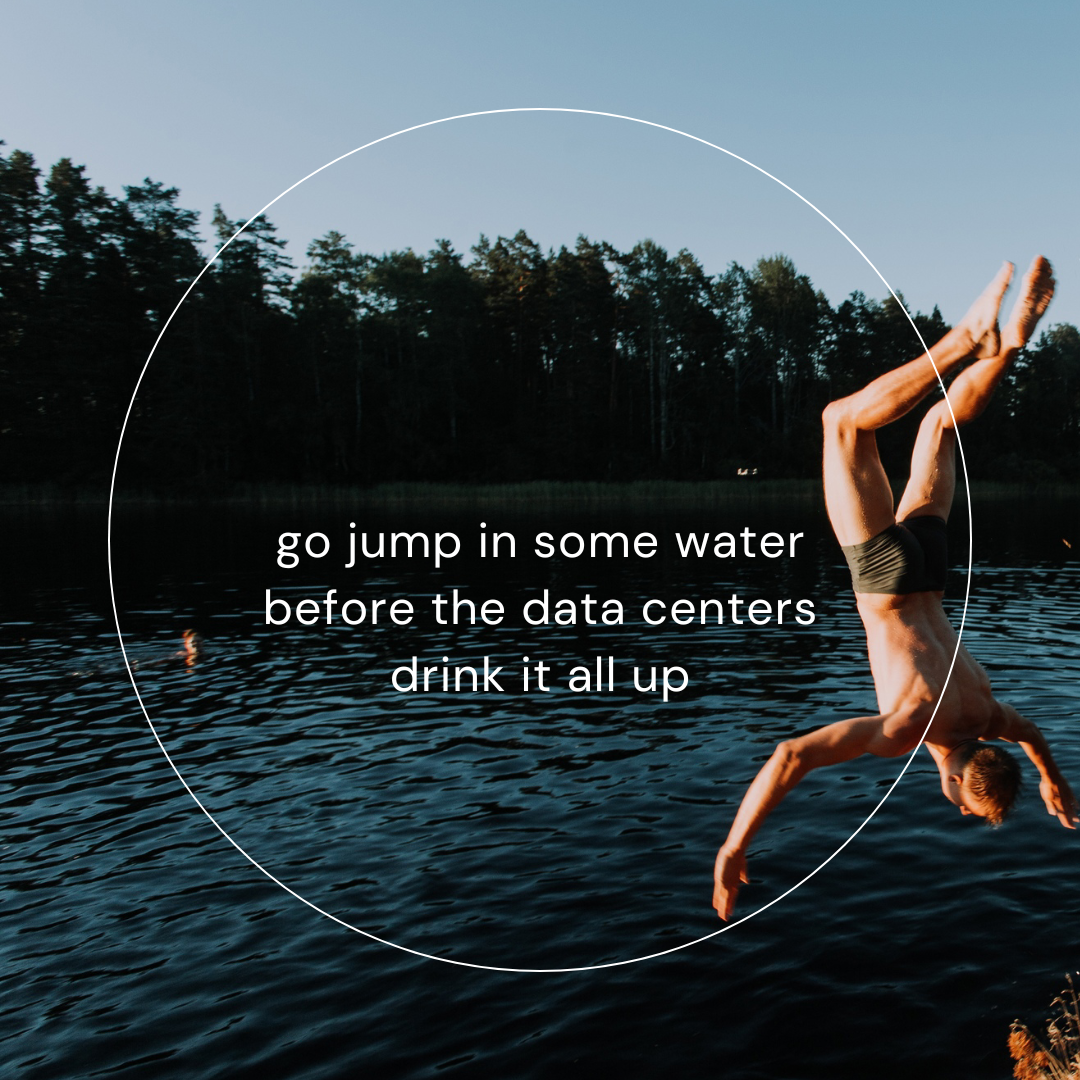
The spotlight picture is actually a campaign slogan from Polaroid, advertising an analog life while stressing a major issue of AI technologies: AI systems need enormous cooling for their energy‑intensive servers, and as reported from multiple sources, the areas where data centers are built often have limited or polluted water resources. Obviously leading to less quality of life for humans, animals and nature surrounded. In perspective: Recent studies show that training a single large AI model can consume over 700,000 liters of clean water, mostly for cooling and electricity generation. Globally, data centers already consume around 1% of all freshwater, a number projected to rise sharply with AI expansion in basically all areas of our lives. Summarized, this environmental risk is existential, and the effect on our brain isn’t beneficial either!
It’s quite logical that it does not support our brain development, when you think about how differently we focus when we write an important email ourselves versus generating it with AI, while not even spelling the prompt correctly. When people rely on AI to write essays or generate ideas, their neural engagement drops, and the brain regions responsible for critical thinking and deep processing become less active. Using AI for thinking tasks noticeably reduces brain activity compared to doing them ourselves; people show lower engagement in regions responsible for focus and critical thinking, creating a kind of cognitive debt that can weaken independent problem‑solving over time. As AI becomes part of daily life, understanding these effects is essential to protect the skills that make human thinking unique.
Additionally, constant algorithmic stimulation creates dopamine loops similar to addictive behavior, weakening attention and impulse control. In simple word: AI use keeps us happy and therefore hooked as we do not want the dopamine kicks to end.
The question is: where do we end up when we live in a world full of comfort, while AI takes up anything we feel uncomfortable with? The answer lies (suprise!) in a German fairytale: The story of Schlaraffenland! Schlaraffenland is a mythical place where food falls from the sky, people never work, and everything is effortless.The story is a satire of comfort, showing how too much ease leads to passivity, dullness, and eventually losing yourself. This links back to the constant dopamine kicks in AI: when we get used to constant comfort, we need more dopamine, and the threshold rises, leading to a destructive cycle designed for us to never be able to keep up with the dopamine needed by our body. A spiral that can only make us lose in the chase for more.
Is this article only bashing AI? No. I’d be quite a hypocrite building this website with AI support and then telling everyone how bad it is. Ever‑evolving technology is part of our history. The more we move forward, the easier life becomes. Let's take the example of communication: We went from to writing letters by hand, to printing books, to carrying phones everywhere, and now we’re at a point where AI writes our messages for us. All of that happened within just a few generations, from slow, intentional communication to instant, automated replies. So what I’m advocating for is simply a more MINDFUL use of it. Be honest, do we really need this AI‑generated cat video? This AI‑written email? Psychological advice from a tool that answers in our favor? And look at how we use emails now. One person writes it with AI, the other responds with AI, two AIs talking to each other in an over‑friendly text block, replacing the discomfort asking difficult questions unfiltered. All that while risking environmental damage and potential making us a little dumber than yesterday. But the reality is: nobody really cares about the typo, the unperfect concept. It might be more comfortable to deliver the polished version, but less connected to our unfiltered selfes.
But where does a world with less connection lead? Less connection to people, to life, to overcoming challenges. Isn't the real human experience about trying a path, making mistakes, or (even better) succeeding based on your own thinking. It’s time we start trusting our own thinking again, it’s still stronger than we give it credit for. Life is about unfiltered connections, making as many experiences as possible.
Fact is, we long for more real experiences. The popularity of ads like Polaroid shows exactly that, a growing desire to reconnect with analog life and genuine moments. Experience tourism is booming, with global demand for hands‑on travel. One of the most famous examples is the Italian pasta‑making class on Instagram, where strangers cook together, sing Italian songs, and turn a simple kitchen activity into a full, joyful experience.
But how do we create experiences in our everyday lives? Surprisingly, it starts with something very unspectacular: learning how to be bored. Boredom activates the brain’s default‑mode network, pushing us toward spontaneous moments, the random meetup, the strange new hobby like knitting. It connects us to others, strengthens our synapses, turn into experiences and shapes our personality.
So next time you make use of your comfort AI tool, think if the world really needs another AI generated cat picture or if you need to be in a world full of cold ocean dips!
Sources:
MIT Study: AI Causes Reduction in Users' Brain Activity — Just Think | Just Think AI
https://www.iea.org/reports/electricity-2024/data-centres-and-ai
https://med.stanford.edu/news/all-news/2022/07/dopamine-digital-addiction.html