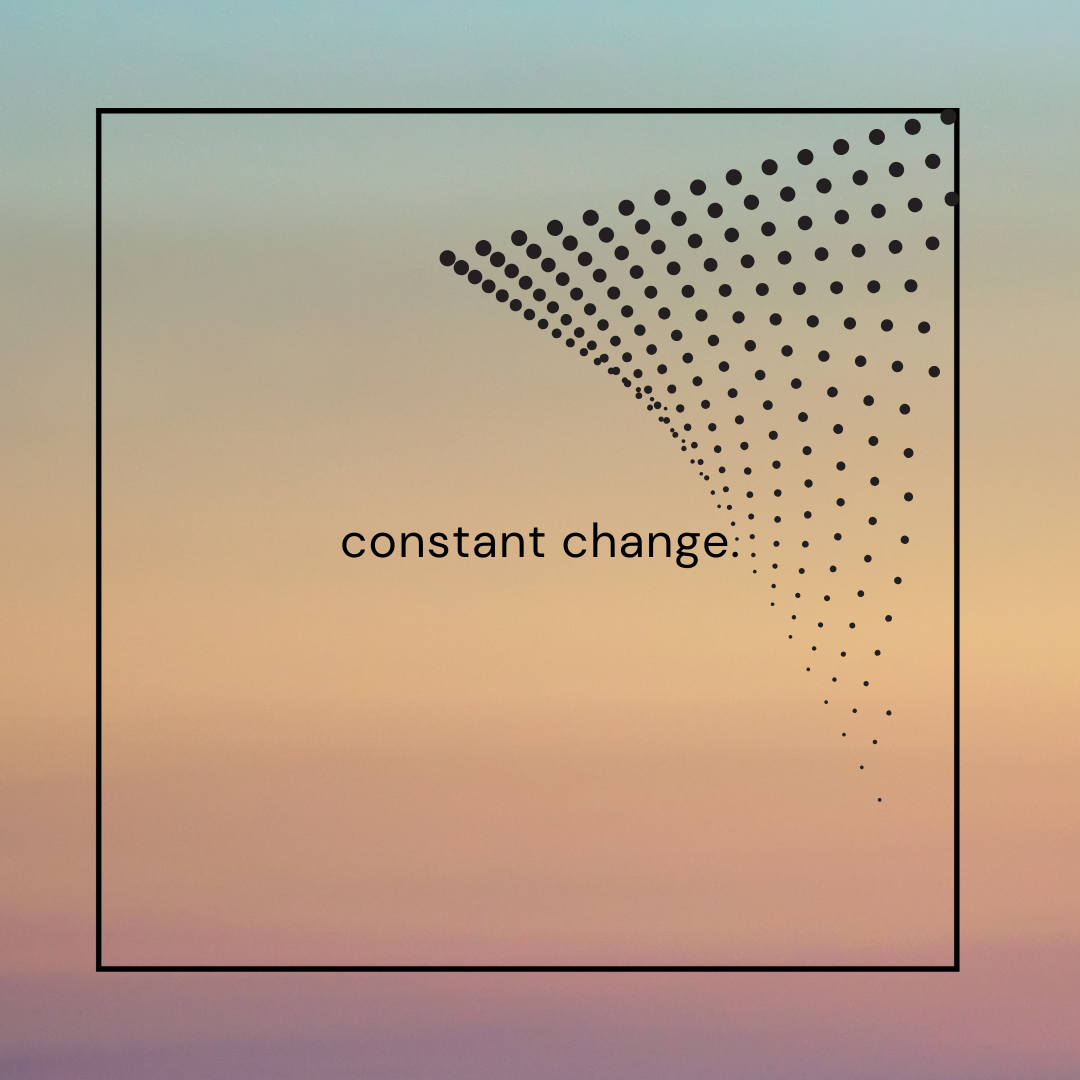
Take a look at the headline picture, you have seen this colour scheme multiple times in your life, on vacation while sitting on a sandy beach or from your window while brushing your teeth. It’s the most celebrated and ignored phenomenon in our world: our beautiful sunset. Unique colour palettes each day, depending on humidity, clouds, the latitude, and how we are able to process the colours based on our internal life.
Nature is not only full of change, it is change. The four seasons, the natural cycle of planting a seed, nurturing it to grow, and caring for it until we pick the fruits, all while accepting the ending of one cycle and trusting that a new cycle will bring different challenges with it. Different weather, external predators, and unforeseen catastrophes. So we live in an environment that naturally changes in cycles, why is it hard for us to adapt to changes in our professional life?
Time for my favourite story, approximately told 100 times in only 2 seminars, but it’s just so fascinating how our brain is conditioned the same way it was when we were hunter‑gatherers. Imagine you are back in the jungle. You have your territory, you have your natural animal predator, a mammoth for example. It announces itself from afar, and you know the unvisble can only mean one thing: danger. You need to get ready to survive. So you either fight, flight, or freeze as your brain’s natural stress response is activated. All your blood flows to your vital organs, and your brain focuses on reacting, not on strategic thinking.
In neurological terms: The fight‑or‑flight response begins in the amygdala, a small almond‑shaped structure deep in the temporal lobe. When it senses a threat, it sends an alarm to the hypothalamus, which sits at the base of the brain, just above the brainstem. The hypothalamus activates the sympathetic nervous system, triggering the adrenal glands to release adrenaline. This increases heart rate, breathing, and muscle readiness. If the threat continues, the HPA axis releases cortisol, keeping the body alert. During this process, blood flow shifts away from the prefrontal cortex, the front part of the brain behind the forehead responsible for strategic thinking, making clear reasoning harder. Most interesting part? Even modern stressors like deadlines activate this ancient survival circuit because the brain treats uncertainty (will we make it?) as potential danger.
It can be an e‑mail from the boss.
It can be the announcement of “needing to talk.”
It can be the message that from now on we will have a different X‑process.
Our brain perceives change as stress, because uncertainty activates the same neural stress circuits as physical threat. Stress research further demonstrates that unexpected or novel conditions force the brain to rapidly reconfigure neural networks, increasing metabolic demand and activating the HPA axis, which releases cortisol to maintain alertness . Reviews in Nature Reviews Neuroscience confirm that synapses become more reactive under uncertainty, because the brain interprets unpredictability as a potential threat, leading to heightened vigilance and reduced cognitive flexibility. Together, these findings show that change is stressful not because it is negative, but because the brain treats any deviation from the expected pattern as a possible danger, triggering energy‑intensive stress mechanisms designed for survival.
Fun Fact: Learning something new requires significantly more energy, the brain uses up to 20% of the body’s total energy, and during intense learning, energy consumption increases even further!
So what happens when something in our work environment changes?
Let's look beyond the traditional change‑management tools such as ADKAR, Kotter, Lewin, and the McKinsey 7‑S model. We will simplify and take a look at the individual first. An individual in the group might act differently due to social dynamic. You know those dynamics are well known from our teenage years as social pressure; it required us to not only look super-cool in dirty chucks but also agreeing to the collective opinion that "Zac Efron is so so cool!". Even though we usually have a better sense of self in our adult years, social dynamics are still very impactful. In our professional life there is there is a third layer on how we adapt to change, the organizational narrative. It describes the tone of your company, is the communication generally positive the personal perception of transitions is perceived even more positive.
First of all, we need to understand one fundamental concept of change: Change means losing the known and making space for the unknown. No one kept a tube TV under a flat-screen or kept the old job while working in the new one. So transitioning at work usually means losing (for example transitioning to new platform) leading to losing old routines, habits, expertise, social status, sense of belonging, calmness of knowing ... and much more deeply rooted feelings.
The Kübler‑Ross–based Change Curve outlines common emotional reactions such as shock, denial, anger, blame, depression, confusion, and acceptance, which have been widely applied to organizational change to normalize emotional responses to the loss of the familiar. Although originally developed for grief, it has been adapted to describe how people emotionally process disruptive times of change. As we are human beings and not robots following a fixed schema, individuals do not move linearly but fluctuate between phases depending on their sense of loss of the familiar and the level of uncertainty perceived.
Looking at that, how would you guide someone through change? Announce excitedly and expect everyone to cheer and get right to work to implement? No. Change is an emotional process with set-backs, with wins followed by confusion. The two main factors needed internally from each leader are patience and reduction of uncertainty.
How? Prepare not only the end goals but the change process with transparent, clear communication and willingness to engage your team! Instead of dictating the change, divide the task and make everything so transparent that there is almost no room left for feeling uncertainty.
Just like the sunset transitions appear different depending on the external factors, leaders can take control to shape the external factors communication and engagement to make it a successful one!
...and in case someone needs a reminder on how beautiful transitions can be, bring them to your favourite sunset spot!
Source: Dynamic brain network reconfiguration under stress: A multiphase fMRI study - ScienceDirect
Source: Leveraging Neuroscience in Transformational Change | Twenty2 Collective